

WiMoCSI Research Platform
The Future of Contactless Elderly Health Monitoring
An aging population needs unobtrusive ways to recognize mobility changes and support independent living. WiMoCSI explores privacy-conscious health monitoring through everyday Wi-Fi—without cameras or wearables.
Starting with motion detection and walking-speed research, we combine physics-based simulation, controlled Wi-Fi experiments, and reliability evaluation. Future directions include fall detection, vital signs, and long-term health monitoring.

The Growing Aging-Care Challenge
 The Growing Aging-Care Challenge
Aging demographics, care demand, and healthcare costs create the need for scalable, lower-burden monitoring solutions.
A rapidly growing older-adult population is increasing the demand for long-term and in-home care, with more falls, emergency visits, and dementia cases. This creates a clear need for scalable, lower-burden monitoring solutions that can help maintain safety, detect changes earlier, and support independent living.
Aging-care systems also face pressure from workforce constraints and rising care complexity, increasing the value of practical, privacy-preserving monitoring approaches that can support earlier awareness, better planning, and more efficient use of care resources.
These challenges are driving the need for scalable solutions that are easy to deploy, reliable, and independent of daily routines — helping older adults live safer, healthier, and more independent lives.

U.S. adults aged 65+
2025 · U.S. Census

Residential-care community residents
2025 study · CDC/NCHS

Older-adult fall-related emergency visits
2024 · CDC

U.S. adults 65+ with Alzheimer's dementia
2026 · Alzheimer's Association
Why this matters
 Why this matters
Scalable monitoring needs — A growing and higher-volume care population requires scalable, low-burden monitoring approaches.
Opportunity for earlier awareness — Continuous, unobtrusive sensing may help identify mobility and safety changes earlier.
Supporting independent aging — Monitoring insights can inform timely support and care planning to help older adults maintain independence longer.



The Need for Scalable Monitoring
 The Need for Scalable Monitoring
Aging population — A large and growing population of older adults (64.6M in the U.S.).
Rising care demand — Higher residential-care needs (~1.0M) and more fall-related emergency visits (~4.5M).
Increasing cognitive risk — Millions are living with Alzheimer's dementia (7.4M).
Need for practical solutions — Scalable, low-burden approaches are needed to support safety and independence.



Sources: U.S. Census Bureau 2025 population estimates (released 2026); CDC/NCHS 2025 residential-care study (published 2026); CDC fall-related emergency department visits (2024 data, reported 2026); Alzheimer's Association 2026 Facts and Figures (modeled estimate).
The WiMoCSI Platform Vision
 The WiMoCSI Platform Vision
A modular, extensible Wi-Fi sensing platform for elderly health monitoring, evolving from mobility sensing to multi-dimensional health insights and real-world healthcare applications.

Goal: Contactless, continuous, and privacy-conscious health monitoring for safer, more independent aging.
WiMoCSI is developing a modular, extensible Wi-Fi sensing platform that turns everyday wireless measurements into meaningful health information for older adults. The platform begins with mobility sensing and will expand to fall-related events, vital signs, and longitudinal health insights, providing a foundation for real-world healthcare and aging-care applications.
Mobility & Movement
Current research
Falls & Safety Events
Future research module
Vital Signs
Future research module
Longitudinal Health Insights
Long-term research goal
Evidence-Aware Analytics & Integration Layer
Cross-cutting foundation





 Potential Applications:
Where We Are Today
Current evidence comes from simulation, controlled experiments, and ongoing reliability research.

Physics-Based Simulation

Model human motion and Wi-Fi signal changes to understand the sensing mechanism and guide system design.

Controlled Wi-Fi CSI Experiments
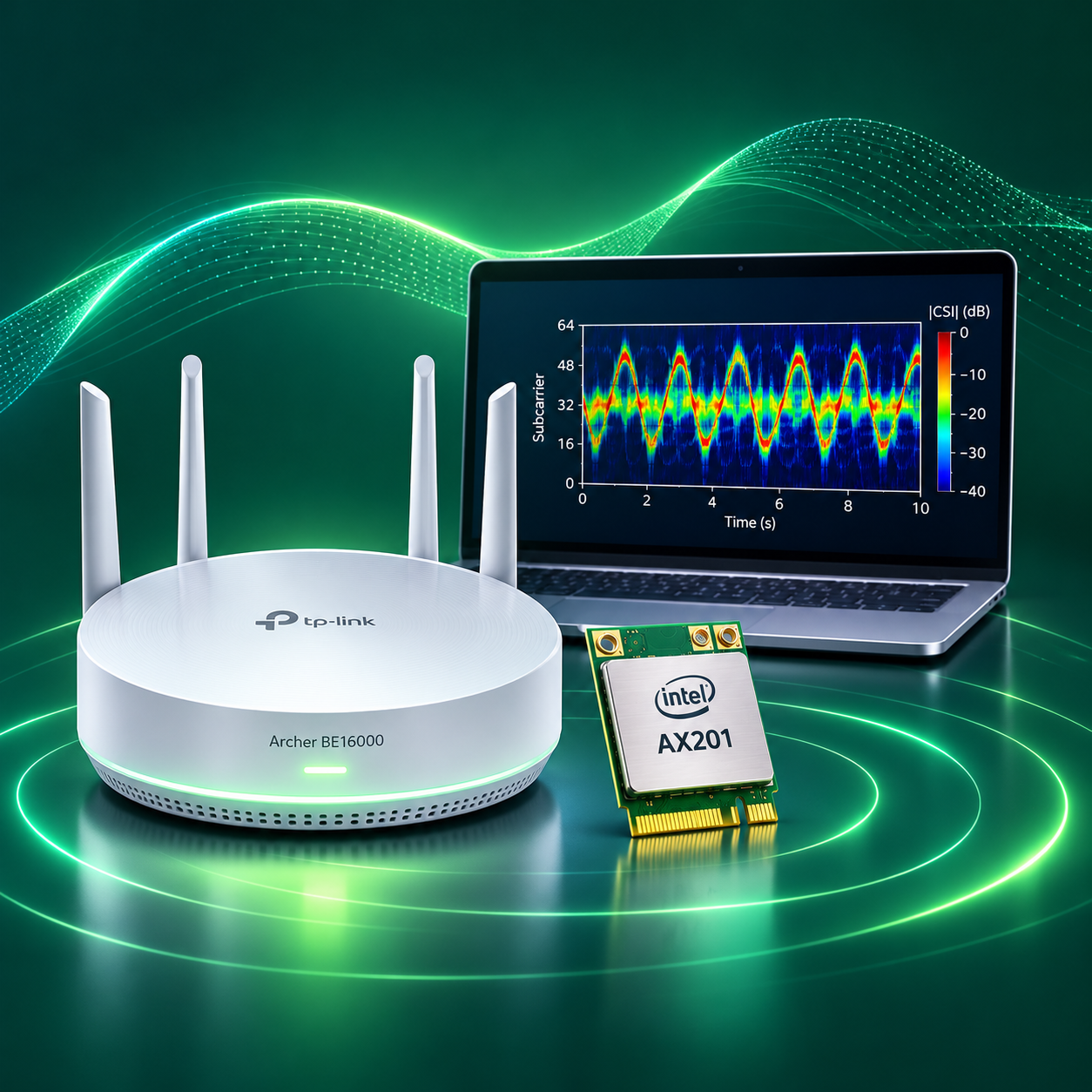
Collect and analyze Wi-Fi CSI data with Intel AX201 in controlled settings to extract mobility features (e.g., walking speed).

Reliability & Generalization Research
Walking-speed estimation is the first module, demonstrating that Wi-Fi CSI can reliably capture human mobility under multiple conditions. Broader validation — including diverse populations, activities, and real-world environments — remains in progress.
Market & Business Opportunity
Demand for better monitoring is growing, as senior care needs rise and healthcare systems face increasing pressure to support older adults efficiently and safely.
WiMoCSI aims to meet this need, through contactless, privacy-conscious Wi-Fi sensing that can measure mobility and potentially support safety and health monitoring without cameras or wearable devices.
The strongest market opportunities, are in senior living, aging at home, healthcare, and aging research, with future commercialization depending on independent validation, clear customer value, and real-world integration.
Target Markets
 Target Markets
Potential WiMoCSI Offering (Value)
 Potential WiMoCSI Offering (Value)
- Senior living & memory care
Contactless monitoring of mobility, fall risk,
and activity patterns in senior living and memory care. - Aging in place (home care)
In-home activity and safety monitoring
using existing Wi-Fi, without wearable devices or cameras. - Healthcare & remote monitoring
Mobility and safety indicators integrated
with clinical and remote care workflows for early intervention. - ADRD & aging research
Longitudinal, non-invasive data collection
(e.g., gait, activity, routine changes) for aging and ADRD studies. - Wi-Fi / smart-home industry
Sensing modules, SDK, and analytics
for integration into smart-home and IoT products.






Key Application Areas
Research institutions — Use Wi-Fi sensing for aging, mobility, and ADRD studies.
Aging-health partners — Senior living, home-care, and care organizations exploring contactless monitoring.
Technology-deployment / OEM partners — Integrate WiMoCSI sensing and analytics into existing Wi-Fi or smart-home solutions.


Investment & Commercialization Roadmap
From Wi-Fi mobility research toward a modular health-monitoring platform, with progress tied to measurable technical, healthcare, and commercial milestones.
WiMoCSI is advancing in phases from controlled Wi-Fi mobility research toward a scalable health-monitoring platform for older adults.
The immediate priority is to prove reliability beyond development data through independent evaluation across people, rooms, devices, and walking conditions.
With successful validation, the platform could expand to falls, vital signs, and longitudinal monitoring, while commercialization will depend on technical performance, customer demand, partnerships, IP, and deployment economics.
 Current Position
- 1
Mobility Foundation
Wi-Fi CSI, simulation and controlled studies.
- 2
Prove Mobility Reliability
Independent evaluation across people, rooms and devices.
- 3
Expand Monitoring Platform
Add fall, respiration and heart-rate sensing.
- 4
Healthcare & Senior Living Pilots
Assess clinical value, usability and costs in real settings.
- 5
Commercialization & Market Expansion
IP, licensing, partnerships and scalable deployment.





Early Commercial Readiness


Assess institutional IP and licensing rights

Test customer use cases

Evaluate deployment economics

Next Investment Milestone
Test reliable mobility estimation beyond controlled development data.

Funding Pathways & Strategic Partnerships
- Current activity: LOIs and competitive applications are being pursued to support aging-health research, independent validation, and pilot development. No funding has been awarded.
- Future pathway: commercialization-oriented support may include potential SBIR/STTR, strategic partnerships, licensing, and technology-development opportunities.
Note: Stages are conditional on research, validation, and partnership progress.
Commercial Opportunity & Value Creation
From Wi-Fi mobility research toward potential research services, technology licensing, and aging-care applications.
Commercial value can emerge in phases, beginning with research tools and validation services, expanding through software and OEM integration, and ultimately supporting aging-care monitoring applications.
Across these stages, practical customer value depends on independent validation, demonstrated usefulness, viable licensing or service models, and scalable partnerships.

Research Tools & Validation
Sponsored research, benchmarking, and technical services.
Near-term opportunity

Sensing Software & OEM Licensing
Algorithms, quality analytics, and technology integration.
Development pathway

Aging-Care Monitoring Services
Validated monitoring for senior living and home care.
Long-term vision
Potential Customer Value
 Potential Customer Value
- Unobtrusive monitoring
- Mobility trends
- Workflow support
- Technology integration
 Unobtrusive monitoring
 Mobility trends
 Workflow support
 Technology integration
Building the Investment Case
 Building the Investment Case
Validated performance (accuracy, coverage, and reliability)
Verified demand (customer discovery and pilot interest)
Commercial rights (institutional IP and licensing arrangements)
Sustainable economics (deployment requirements and customer value)




Partner in the Next Phase of WiMoCSI
Help advance contactless monitoring for older adults through independent research, healthcare validation, and technology development.

What WiMoCSI Brings
Physics-Based SimulationReproducible experiments linking human movement to Wi-Fi signal behavior.

Commodity Wi-Fi ResearchControlled CSI recordings and reference measurements for investigating mobility sensing.

Evidence-Aware DevelopmentResearch methods that examine measurement limitations, uncertainty, and generalization.

Partnership Opportunities

Research & Validation PartnersCollaborate on independent experiments, mobility reference measurements, and reproducible performance evaluation.

Healthcare & Aging-Care PartnersHelp identify meaningful monitoring needs, develop observational studies, and evaluate future applications in senior living and aging at home.

Technology & Funding PartnersSupport defined research milestones, investigate Wi-Fi sensing integration, and explore licensing or translational-development opportunities.

Our Next Shared MilestoneEstablish independently reproducible Wi-Fi mobility measurements that can support the next phase of research into contactless older-adult monitoring.
Discuss a Partnership